Too Many Choices, Not Enough Watching: The Streaming Trap Nobody Warned You About
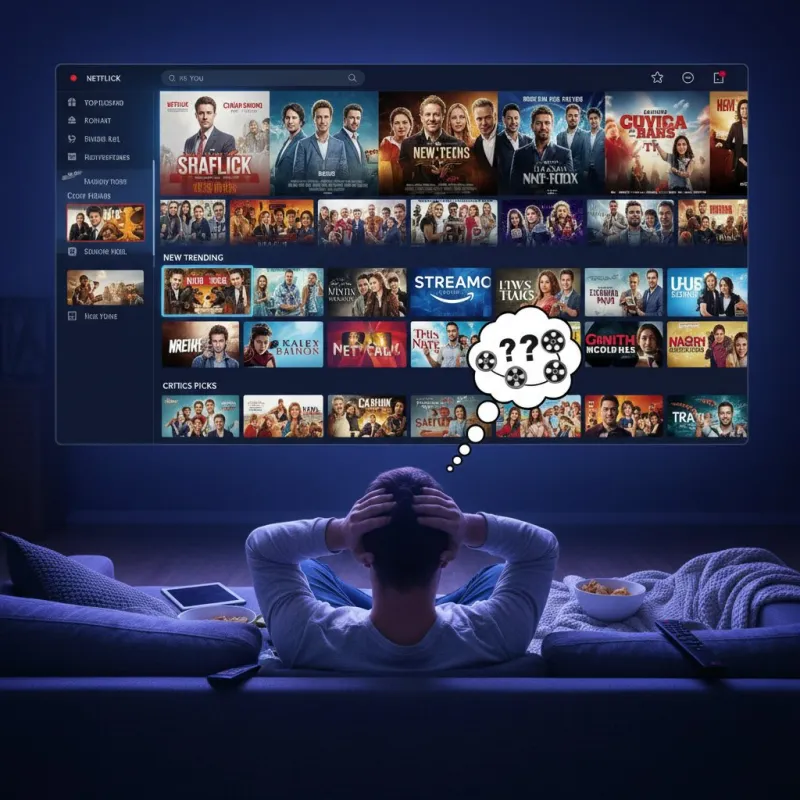
Photo: person overwhelmed staring at TV remote with streaming app icons on screen, via obrazki.ai
You did everything right. You ditched the cable company, grabbed a Roku or a Fire Stick, and stacked up a solid lineup of streaming services. Netflix, Hulu, Prime Video — maybe HBO Max and Peacock thrown in for good measure. The promise was simple: watch whatever you want, whenever you want, no commercials (mostly), no contracts (mostly), total freedom.
So why does it feel like you're watching less than you ever did?
If you've found yourself spending more time scrolling through thumbnails than actually hitting play, you've stumbled into what psychologists call decision paralysis — and streaming platforms have essentially built their entire user experience around it. Buckle up, because we're going to untangle why your cord-cutting dream has quietly become a frustrating chore, and more importantly, what you can do about it.
The Paradox of Choice Is Very Real — and Very Annoying
Back in the cable days, the experience was passive in a way that actually worked in your favor. You'd flip on TNT at 8 PM, catch whatever movie was already ten minutes in, and just... watch it. No commitment required. The decision was made for you, and honestly? That was kind of fine.
Streaming flipped that model entirely. Now you're the programmer. Every single night, you're essentially running your own one-person TV network, curating a lineup from a catalog of tens of thousands of titles. Research psychologist Barry Schwartz wrote about this exact phenomenon in The Paradox of Choice — the idea that more options don't make us happier, they make us more anxious. Every choice you don't make feels like something you're missing out on. Every show you pick carries the weight of everything else you could've been watching.
Netflix alone has over 36,000 hours of content available in the US. That's not a feature. That's a cognitive burden dressed up as entertainment.
The App-Hopping Problem Nobody Talks About
Here's another layer of friction that doesn't get enough attention: the sheer mechanical effort of navigating multiple apps. Cord-cutting was supposed to simplify your life, but for a lot of people, the reality looks something like this:
You open Netflix, browse for a few minutes, don't find anything that grabs you. You back out, open Hulu, repeat. Then Prime Video. Then maybe you remember there was something on Peacock you bookmarked two months ago — except you can't remember your Peacock password and the reset email is going to your old address.
By the time you've cycled through your apps, twenty-five minutes have passed. You're tired. You put on something you've already seen.
This isn't a personal failing. It's a structural problem. Streaming services are intentionally siloed — they don't want you to leave their platform, so they have zero incentive to make cross-app browsing easy. The result is a fragmented experience that makes finding a good show feel like a part-time job.
Content Fragmentation Is Getting Worse, Not Better
Remember when Friends and The Office were both on Netflix? Those days are long gone. Rights deals have scattered beloved content across a growing number of platforms, which means that following your favorite shows or movies often requires subscribing to whichever service just won a bidding war.
The average American household now subscribes to four streaming services, according to recent data from Deloitte. That's four monthly bills, four separate apps, four content libraries that don't talk to each other, and four different recommendation algorithms all competing for your attention. It adds up — financially and mentally.
Worse, the content itself has become harder to evaluate. Streaming services have flooded the zone with original programming, much of it mediocre, because volume is part of the retention strategy. If there's always something new, you might not cancel. But wading through a sea of forgettable originals to find the one genuinely great show? Exhausting.
Why Your Brain Misses the Cable Days (Even If Your Wallet Doesn't)
There's a nostalgia factor worth acknowledging here. Cable TV, for all its expense and bloat, offered something streaming still hasn't fully replicated: appointment viewing. Watching Breaking Bad on AMC when it aired, knowing millions of other people were watching the same episode at the same moment, was a communal experience. Water cooler conversation was built on that shared schedule.
Streaming democratized access but atomized the audience. When everyone is watching different things on different timelines, the cultural conversation fragments. You finish a show two years after it dropped, and there's no one left to talk to about it. That low-grade loneliness around entertainment is real, even if it sounds a little dramatic to say out loud.
How to Break the Cycle and Actually Enjoy What You're Paying For
Okay, enough doom and gloom. Here's the practical stuff.
Set a "watch next" list and actually commit to it. Before you sit down for the night, decide what you're watching. Don't browse in the moment — that's where paralysis lives. Pick something in the morning or during lunch when you're not tired and impulsive.
Rotate your subscriptions. You don't need all five services running simultaneously. Subscribe to two or three at a time, binge what you want, cancel, then rotate in different ones next month. This keeps costs down and gives each platform a focused window of your attention.
Use a universal guide app. Tools like JustWatch or Reelgood let you search across multiple platforms at once and see where content is streaming. This eliminates the app-hopping loop and makes the whole experience feel a lot less like work.
Embrace the algorithm occasionally. Yeah, we know — algorithms can feel manipulative. But sometimes letting Netflix or Hulu make the call for you isn't the worst thing. The passive viewing experience cable gave us wasn't all bad. Occasionally just hitting play on whatever your home screen is surfacing can short-circuit the paralysis entirely.
Bring back appointment viewing. Pick a show to watch with a partner, friend, or family member on a set night. The social commitment removes the individual decision burden and brings back a little of that communal energy streaming tends to drain away.
Cutting the cord was the right move for a lot of reasons — cost, flexibility, control. But freedom without structure can quietly become its own kind of frustration. A little intentionality goes a long way toward making your streaming setup actually work for you instead of against you.